
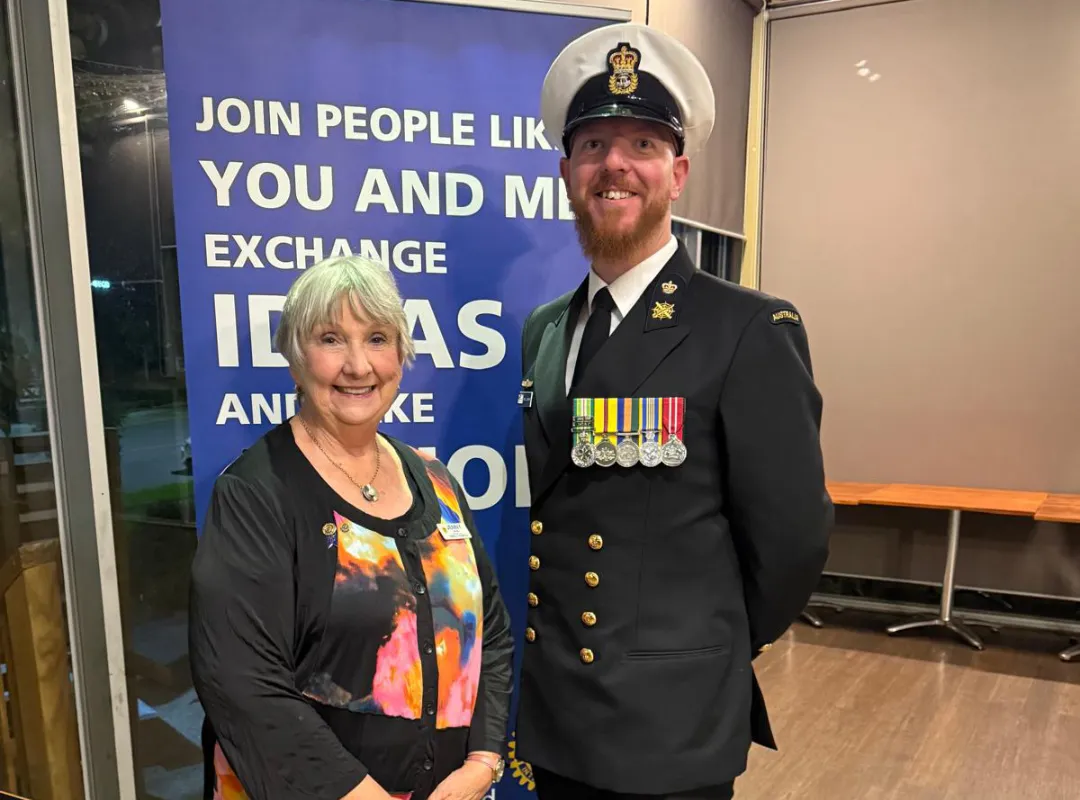
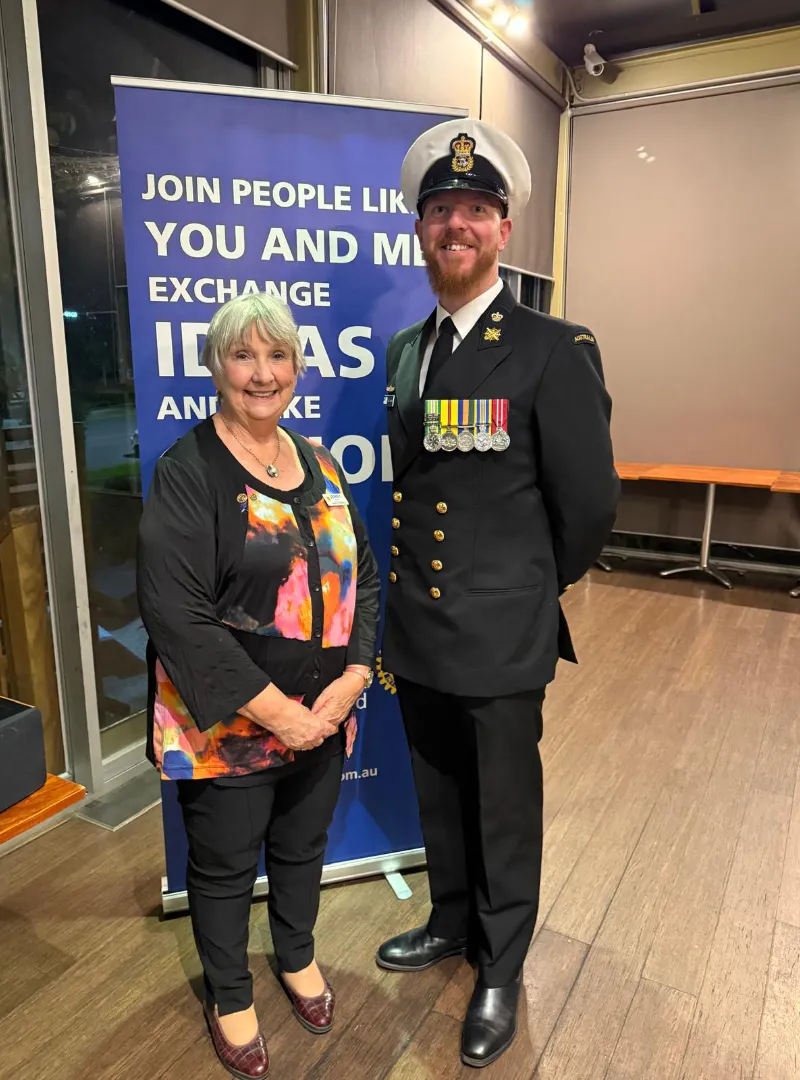
With ANZAC Day coming up this week, it was timely to hear from Chief Petty Officer David Jordan, serving in the Australian Navy, who talked about his pathway into the Navy, the changes that have become apparent in the Armed Services over this time and what ANZAC Day means to him.
In his final year at school David was keen to become a firefighter, as he was a member of the Selby Fire Brigade. Realising that he would only be accepted with some life experience, he considered joining the Army but ultimately enlisted in the Navy, where he trained to become a Combat Systems Operator (CSO). The CSO is responsible for the above water combat, which is now a very technical task, compared to 20 years ago when David worked initially with HF circuits. After training at Cerberus and in Sydney, David joined HMAS Paramatta for a three year stint which included travelling to the Middle East, around South-East Asia, North-East Asia, China and Russia. A promotion to leading seaman led to a shore job, after which time he volunteered for HMAS Tobruk. This was a great experience, despite the age and limitations of the ship, as he worked with a small group in the Ops Room and had a great deal of responsibility.
After six years in the Navy, David opted to reconsider his ambition to be a firefighter, leaving the Navy and applying to the CFA. He was devastated when he did not get an offer, even though he had reached the interview round. After working in various jobs such as being a yoga instructor, David returned to the Navy and quickly gained a promotion to Cerberus as a Petty Officer, training people in aspects such as presentation skills. A posting to HMAS Watson came with a promotion to Chief Petty Officer and the task of Chief Instructor in Maritime Warfare. David hopes to become a Lieutenant in the coming year or two and we look forward to following his progress.
One challenge for leadership in the armed services of today is to keep the standards up, such as the standard of fitness. The armed services have changed and in many ways are keeping up with the times, for example, there is a lot more flexibility with haircuts and dress standardsand beards are allowed. Coming out of the Vietnam War, the Armed Service’s culture was not good: change was needed both culturally and organisationally. This has led to the New Generation Navy, where the old regime of bullying and strict hierarchy no longer applies. Everyone in the Navy has a voice now, unlike when the leading seamen were treated like gods; a complaint or a compliment can be freely voiced. A further challenge is to maintain motivation when not in a conflict state. The Navy now is in a training state, largely training for a response to a cyber war, but constant training can lead to ‘training burnout’. A further challenge is that joining the Armed Services is now seen as a way of having an adventure andgaining skills and experience, before leading onto a different job, without a sense of doing service. It was noted that TV advertisements for the Armed Forces reflect this scenario very clearly.
Reflecting on ANZAC Day, David commented that once the day was about catching up with friends and sharing experiences after the March and service. For many it is a way to honour those who served, often with an element of grieving, and he is personally very pleased to see how the younger generation respond respectfully to the atmosphere of ANZAC services, even at the football. For him, personally now, ANZAC Day is a time to gather with family and to acknowledge that family members are the ones who make a sacrifice to enable their loved one to follow this path of service.
Thank you to David for sharing his story in such an engaging and enlightening way.