
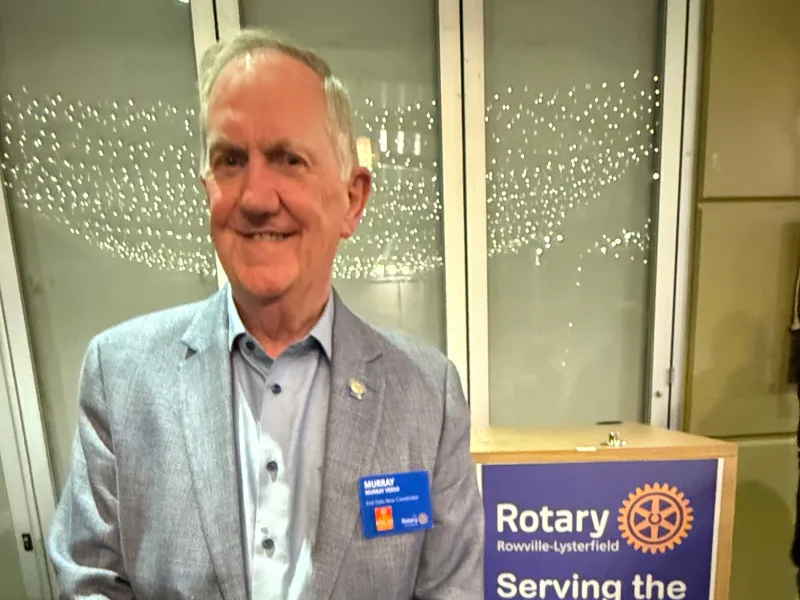
In a very informative presentation, Murray outlined for us what poliomyelitis is, the role of Rotary in the Global Polio Elimination Initiative (GPEI), a brief history of this project, some Australian people who have been significant in the journey towards eliminating polio and some of the current challenges in achieving the goal of polio elimination.
Polio is an ancient disease; early Egyptian pottery vessels have been found that show a priest with a walking stick and a withered leg. Polio is a virus that enters the body through the mouth and attacks the central nervous system. Whichever part of the CNS is attacked determines where the disability occurs. The most common form is when the lower limbs are affected (acute flaccid paralysis). Sadly, polio generally attacks children under five and it can cause death. In addition to causing muscle weakness making mobility difficulty, it can attack the muscles responsible for lung function, so some sufferers only survived by living in an ‘iron lung’, to ensure they could breathe. Murray shared information about one woman who lived for more than 60 years in an iron lung at Fairfield Infectious Diseases Hospital.
In the 1950s in Australia, polio was a feared disease and people went to great lengths to try to ensure their children did not catch it.
Progress towards understanding polio took a leap forward in the 1930s with the work of Australian Sir Frank MacFarlane Burnet who determined that polio was more than one virus; there were in fact three viruses, Type 1, Type 2 and Type 3. He also discovered that the polio virus is absorbed through the gut. A further Australian of note in the history of treatment for polio was Sister Elisabeth Kenny who devised a radically new and controversial method of treating children with massage and exercise. Her methods were not well received so she moved to the US where it was more accepted. The biggest breakthrough in the treatment of polio was in the 1950s with the introduction of a vaccine, created in 1955 by Jonas Salk. In 1966 the Sabin Oral Polio Vaccine (OPV) was introduced in Australia
Polio eradication has been Rotary International’s number one global project for over 40 years. The role of Rotary includes fundraising, raising awareness and advocacy, such as liaising with Government. This project had its origins when Australian Sir Clem Renouf was Rotary International President in 1978-1979. Sir Clem was inspired by the elimination of smallpox through vaccination to investigate if there was another world-wide disease that could be eliminated with the help of Rotary. His focus turned to polio, but approaches to health agencies in the US were rebuffed, so Rotary commenced a pilot project in the Philippines, which was incredibly successful. From this grew a partnership, with Rotary as a founding partner, with WHO, UNICEF, the US Centres for Disease Control and Prevention, the Gates Foundation and Gavi, the vaccine alliance.
Since its inception, over 3 billion children have been immunized and 21 million children saved from paralysis. Now polio is only endemic in two countries in the world, Pakistan and Afghanistan.
A current challenge is that there is a type of variant polio emerging largely in Africa, circulating vaccine-derived poliovirus (cVDPV), that is due to the oral vaccine residual getting into water supplies.
The goals of GPEI are currently:
Goal one – to permanently interrupt the transmission of the polio virus in Afghanistan and Pakistan, by 2025.
Goal two – to stop transmission of cVDPV by 2026
The challenges faced in vaccination programs in the two remaining countries are:
To achieve the goals above will require $US6.9 billion.
Rotary has a goal to raise $US50 million per annum and this will be matched by the Gates Foundation 2:1, up to $US100 million from this Foundation.
Rotary clubs are encouraged to support the End Polio Now program and club members can become individual donors by joining the Polio Plus Society.